
Honoring Juneteenth: How Fashion & Photography Were Used As an Act of Resistance
When the Emancipation Proclamation took effect in 1863, slaveholders in Texas continued to deny freedom to enslaved people. Two and a half years later, on June 19, 1865, Union troops arrived in Galveston, and Major General Gordon Granger issued General Order No. 3, promising that the Emancipation Proclamation would be fully enforced. On that day, enslaved people finally received word: They were free. These words would continue to ring in the ears of the formerly enslaved and their descendants, who would mark this day as one for joy and celebration. June 19, also known as Juneteenth, is the oldest nationally celebrated commemoration of the end of slavery in the United States. In honor of Juneteenth, we will explore how photography and fashion served as forms of self-expression and resistance for formerly enslaved African Americans in the United States.
Fashion & Photography As A Form of Resistance
Throughout history, the African American diaspora has used the power of fashion and photography to subvert stereotypes, reshape identity, and document and preserve their stories. Since the creation of photography, African Americans have used the camera lens as an act of resistance against racist ideologies of what Blackness is in America. During the Reconstruction Era (1861-1865), the dehumanizing depictions of African Americans were seen in newspapers, magazines, postcards, and other print media. To combat this imagery, many freed African Americans would take control of their own narratives by sitting for stylized photographs, such as cabinet cards or carte de visite, dressed in their “Sunday’s best.”
“Negroes can never have impartial portraits, at the hands of white artists. It seems to us next to impossible for white men to take likenesses of black men, without most grossly exaggerating their distinctive features. ” Frederick Douglass, The North Star. April 7, 1849
The art of photography not only helped center the voices of African Americans, but also highlighted the powerful use of fashion of the time. The viewer can see the detail and quality of the sitter’s clothing, hairstyles, accessories, and even facial expressions. Fashion is not only about the style of clothing, but also about one’s expression, language, and movement.
Behind the Photo: The Fashion of Black Women in the 19th-Century
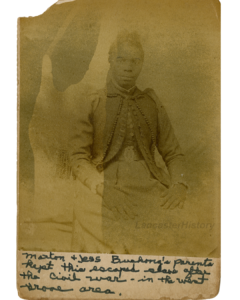
Fashion in the 19th century helped redefine African American identity in the United States. Black women have used fashion as a form of political resistance, self-expression, and connection to their womanhood. In the 19th century, Black women, both enslaved and free, worked as seamstresses and dressmakers, often fashioning their clothes to follow the trends of the time, while also using adornments such as headwraps and colorful fabrics to rebel against enslavers and European standards of fashion and beauty.
In some parts of the country, Black women wore headwraps to honor their African traditions. In the Antebellum South, specifically in Louisiana, Black women were forced to wear a tignon (a type of headwrap). This act, known as the Tignon Laws, was another way to control self-expression and reinforce class and racial segregation.
Pictured to the right is a cabinet card, originally in LancasterHistory’s archived Bushong Family album and now on display at the Thaddeus Stevens & Lydia Hamilton Smith Center for History and Democracy, featuring an unidentified African American woman. The photo, taken in Cecil County, Maryland, has written text at the bottom explaining that the woman escaped slavery during the Civil War and found her way to the Bushong family farm in Chester County, Pennsylvania. The Bushongs were prominent farmers and abolitionists.
“Martin + Jess Bushong’s parents kept this escaped slave after the Civil War – in the West Grove area.”
In the photo, the woman is wearing a braided Zouave jacket, which was popular with women in the 1860s. The jacket, named after the Algerian Zouave infantry, was worn on many occasions in the United States and the United Kingdom. Along with the fashionable attire, she is wearing her hair pinned at the top of her head in a curled, Victorian-style, which free Black women adopted and refashioned to suit their hair texture.
Behind the Photo: The Fashion of Black Men in the 19th-Century
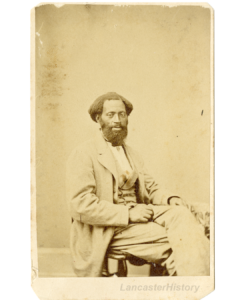
This carte de visite is also part of the Bushong Family Album in LancasterHistory’s archive and is on display in the Stevens & Smith Center. The photograph, taken in 1865 by Alexander McCormick in Oxford, Chester County, features an unidentified formerly enslaved African American man who lived in the county. Written on the back of the photograph:
“Formerly enslaved person who must have stayed on the farm of Henry Bushong Jr., father of Martin and Jesse, or Henry Sr., great-grandfather of Marvin, we don’t know. Both aided the enslaved people in their escape to freedom. Photo taken in Oxford. No photographer in Q-ville.”
The unidentified man is wearing a three-piece suit, which highlights his status as a free man. During slavery, African Americans were forced to wear coarse and low-quality textiles, often referred to as “slave cloth,” “negro cloth,” or “plantation cloth.” During the Reconstruction Era, freed African American men used fashion as a form of resistance and refinement, wearing finer fabrics and following the trends of the time, including the three-piece suit, also known as a “ditto suit.”
Fashion wasn’t the only tool used to showcase one’s status; men’s facial hair was also a determining factor. The man in the photo is sporting a full beard, a style that can be traced back to the Victorian era, possibly at the height of the “beard movement” in the 1850s-1860s, an era that scholars believe shifted the ideals of masculinity across various economic and cultural classes. Black men during this time period were not only examining their racial identity, but also their gender identity.
From Archives Blog, PhotoBlog